
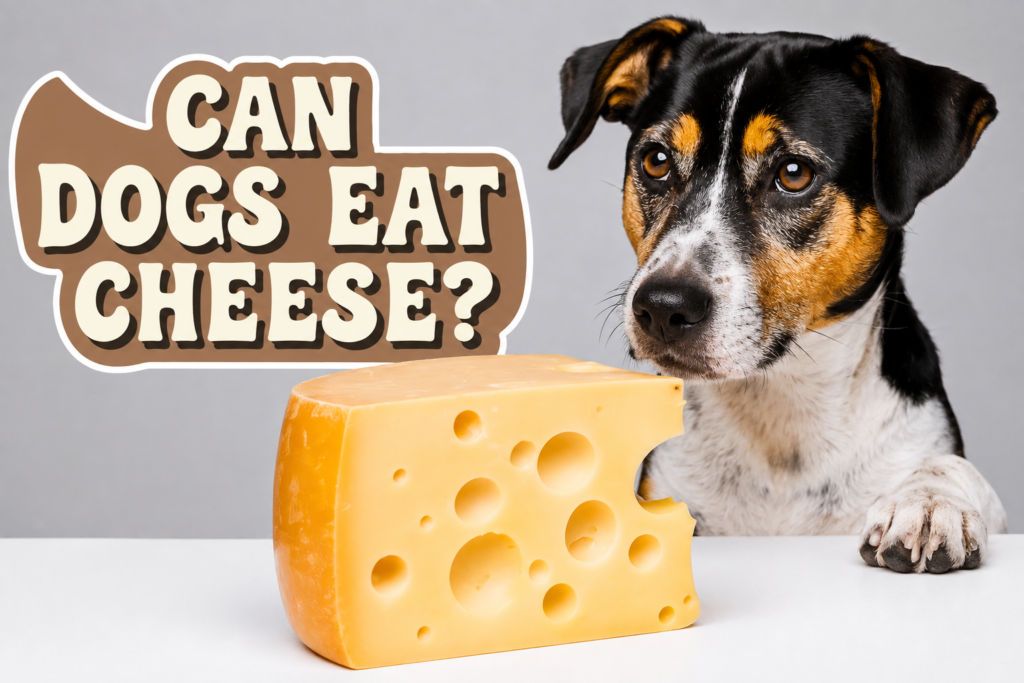
If you are enjoying pasta, pizza, or another meal topped with Parmesan cheese, you may notice your dog sitting nearby and hoping for a small bite. This naturally raises an important question: can dogs eat Parmesan cheese?
The short answer is yes, dogs can eat Parmesan cheese in very small amounts, but it is not an ideal cheese for dogs. Parmesan is not considered poisonous to dogs, but it contains a significant amount of salt and is relatively high in fat. Feeding too much can cause digestive problems, excessive thirst, or more serious health concerns in some dogs.
So, can dogs eat Parmesan cheese safely? It depends on the amount, your dog’s overall health, and how frequently you offer it. A tiny sprinkle of plain Parmesan occasionally is unlikely to cause problems for a healthy dog. However, Parmesan should never become a regular part of your dog’s diet.
This guide explains everything dog owners should know about Parmesan cheese, including its nutritional content, potential benefits, risks, safe serving sizes, alternatives, and what to do if your dog eats too much.
Can Dogs Eat Parmesan Cheese Safely?
Can dogs eat Parmesan cheese without getting sick? In general, a small amount of plain Parmesan cheese is unlikely to be toxic to a healthy dog.
Parmesan is made from cow’s milk and is a hard, aged cheese. Unlike some foods that are directly toxic to dogs, Parmesan does not contain ingredients that are inherently poisonous when consumed in a tiny quantity.
However, “not toxic” does not automatically mean “healthy.”
Parmesan contains considerable amounts of sodium and fat. Dogs have different nutritional requirements from humans, and their regular diet should provide all the nutrients they need without relying on salty human foods.
Therefore, can dogs eat Parmesan cheese as an occasional treat? Yes, a very small quantity can be offered occasionally to some healthy dogs. It should be treated as an occasional extra rather than a normal component of their diet.
The safest approach is to use plain Parmesan without added garlic, onion, spices, sauces, or other ingredients.
Is Parmesan Cheese Toxic to Dogs?
A common concern behind the question can dogs eat Parmesan cheese is whether Parmesan itself is poisonous.
Plain Parmesan cheese is not generally considered toxic to dogs. A dog that accidentally eats a small piece or a little grated Parmesan will usually not experience serious poisoning simply because it is Parmesan.
The bigger concern is its nutritional composition.
Parmesan is highly concentrated because it is aged and contains relatively little moisture compared with soft cheeses. This means a small quantity can contain more sodium than a similar-sized portion of a softer cheese.
This is particularly important for small dogs.
For example, a small Chihuahua and a large Labrador Retriever do not have the same dietary needs. A quantity that seems tiny to a person can represent a much larger portion of a small dog’s daily intake.
So when asking can dogs eat Parmesan cheese, it is better to think about portion size rather than simply whether the food is toxic.
Why Do Dogs Like Parmesan Cheese?
If you have ever wondered why your dog becomes extremely interested when you open a container of Parmesan, there is a simple explanation.
Cheese has a strong smell and contains fat and protein, which can make it highly appealing to dogs. Parmesan is especially aromatic because it is aged.
The smell can attract dogs even when they have never tasted Parmesan before.
This is one reason owners often ask, can dogs eat Parmesan cheese, after their dog tries to lick a plate or steal some cheese from the kitchen counter.
Although dogs may love the smell and flavor, their preference does not mean that Parmesan should be given freely.
Dogs often want foods that are not appropriate for regular consumption. Responsible feeding means controlling portions even when your dog begs for more.
Can Dogs Eat Parmesan Cheese Every Day?
Can dogs eat Parmesan cheese every day? It is better to avoid making Parmesan a daily treat.
Even a small amount can contribute additional sodium and calories to your dog’s diet. Over time, frequent servings may become unnecessary dietary excess.
Your dog’s main food should provide the appropriate balance of protein, fat, carbohydrates, vitamins, and minerals.
Treats and human foods should generally make up only a small portion of the overall diet.
If you use Parmesan as a training reward every day, consider replacing it with a dog-appropriate low-calorie treat. This makes it easier to control your dog’s sodium and calorie intake.
Therefore, can dogs eat Parmesan cheese occasionally? Yes. But daily feeding is generally unnecessary and not recommended.
Nutritional Value of Parmesan Cheese
Understanding Parmesan’s nutritional characteristics helps explain why the answer to can dogs eat Parmesan cheese is not simply yes or no.
Parmesan contains:
- Protein
- Fat
- Calcium
- Phosphorus
- Sodium
- Calories
- Small amounts of other nutrients
Protein and calcium are useful nutrients, but dogs should obtain these nutrients primarily from a complete and balanced dog food.
The high sodium content is one of the biggest concerns with Parmesan.
Because Parmesan is aged and concentrated, it can contain considerably more salt than some other cheeses. Dogs need sodium in their diets, but excessive sodium is unnecessary and can be harmful.
This is why can dogs eat Parmesan cheese should always be answered with moderation in mind.
Can Dogs Eat Parmesan Cheese for Calcium?
Some owners wonder whether Parmesan can be used as a calcium source.
Parmesan does contain calcium, which is an important mineral for bones and teeth. However, giving your dog Parmesan specifically to increase calcium intake is not a good strategy.
Complete commercial dog foods are formulated to provide appropriate mineral levels. Adding large amounts of cheese can disrupt the overall balance of the diet.
Puppies are particularly sensitive to mineral imbalances because their bones are developing rapidly.
If you believe your dog needs additional calcium, speak with a veterinarian rather than adding cheese to the diet without professional guidance.
So, can dogs eat Parmesan cheese for its calcium? A tiny amount may provide some calcium, but Parmesan should not be used as a dietary supplement.
The Biggest Concern: Salt
When people ask can dogs eat Parmesan cheese, sodium deserves special attention.
Parmesan is naturally salty. Dogs can tolerate sodium in appropriate quantities because sodium is an essential nutrient. However, excessive sodium intake can cause problems.
After eating salty food, a dog may drink significantly more water than usual.
A very large sodium intake can cause more serious symptoms, including vomiting, diarrhea, weakness, tremors, or seizures.
The risk depends on how much was eaten and the dog’s size.
A tiny sprinkle of Parmesan on food is very different from eating a large block of Parmesan cheese.
This is why portion control matters so much when deciding whether can dogs eat Parmesan cheese.
Can Dogs Eat Parmesan Cheese If They Have a Sensitive Stomach?
Dogs with sensitive stomachs may react poorly to rich foods.
Parmesan is concentrated and relatively high in fat, so some dogs may develop digestive upset after eating it.
Possible symptoms include:
- Gas
- Loose stool
- Diarrhea
- Vomiting
- Abdominal discomfort
- Reduced appetite
If your dog already has a sensitive digestive system, introducing Parmesan may not be worthwhile.
For these dogs, the answer to can dogs eat Parmesan cheese may technically be yes in terms of toxicity, but that does not mean it is a good treat choice.
A bland, veterinarian-approved diet or an appropriate dog treat is usually a better option.
Can Dogs Eat Parmesan Cheese If They Are Lactose Intolerant?
Another important question is whether Parmesan contains lactose.
Parmesan is an aged cheese, and aging reduces much of its lactose content. As a result, Parmesan generally contains less lactose than many fresh dairy products.
This means some dogs that have difficulty digesting milk may tolerate a tiny amount of aged cheese better than milk.
However, low lactose does not mean completely risk-free.
Individual dogs respond differently to dairy products.
If your dog has previously experienced diarrhea, gas, or stomach discomfort after eating dairy, it is better not to experiment with Parmesan.
Therefore, can dogs eat Parmesan cheese if they are sensitive to lactose? Some may tolerate a tiny amount, but dogs with known dairy intolerance should generally avoid it.
Can Dogs Eat Parmesan Cheese If They Are Overweight?
Dogs that are overweight need careful calorie management.
Cheese is calorie-dense compared with many fresh fruits and vegetables, so even small amounts can add calories to a dog’s daily intake.
If your dog is already overweight, giving Parmesan regularly may make weight management more difficult.
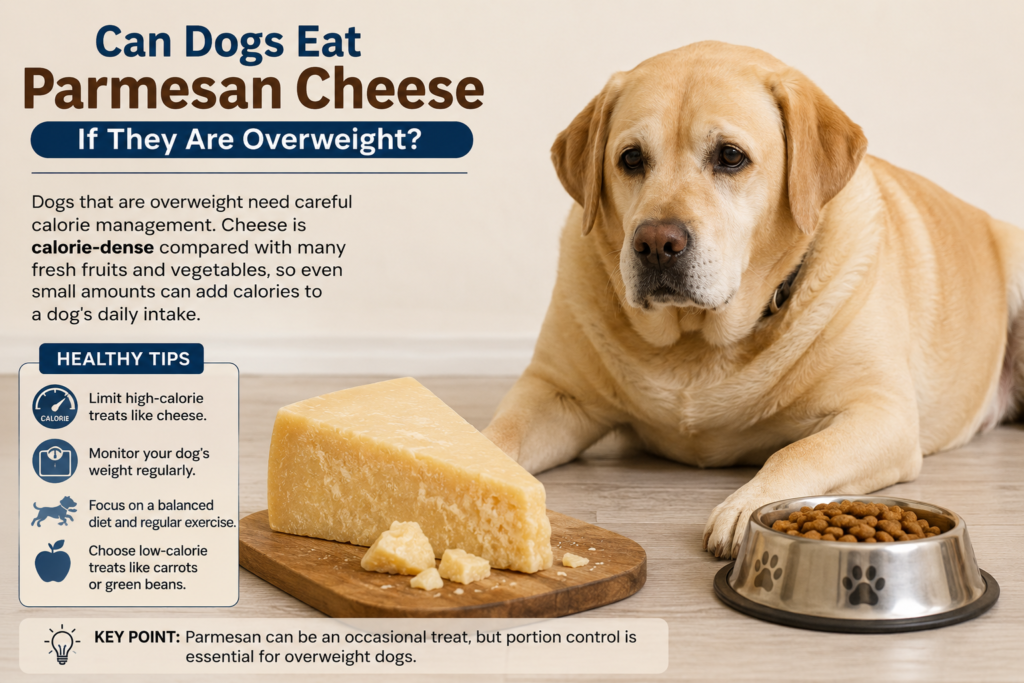
Instead of asking only can dogs eat Parmesan cheese, consider whether the treat fits into your dog’s daily calorie allowance.
If your dog needs to lose weight, low-calorie treats approved by your veterinarian are usually a better choice.
Can Dogs Eat Parmesan Cheese If They Have Pancreatitis?
Dogs with a history of pancreatitis require special care with dietary fat.
Rich, fatty foods can be inappropriate for dogs that have pancreatitis or are prone to digestive problems involving fat.
Because Parmesan contains fat, it should not be casually added to the diet of a dog with a history of pancreatitis.
If your dog has pancreatitis or has been placed on a low-fat diet, ask your veterinarian before offering Parmesan.
In this situation, can dogs eat Parmesan cheese is not something that should be decided solely based on whether Parmesan is toxic. The dog’s individual medical and dietary needs matter much more.
Can Dogs Eat Parmesan Cheese If They Have Kidney Problems?
Dogs with kidney disease may need dietary restrictions involving phosphorus, sodium, protein, or other nutrients.
Parmesan can contribute sodium and phosphorus, so it may not fit into a therapeutic kidney diet.
If your dog has kidney disease, do not assume that a small amount is automatically safe just because Parmesan is not poisonous.
Ask your veterinarian before adding human foods to a prescription or therapeutic diet.
For these dogs, the answer to can dogs eat Parmesan cheese depends heavily on the individual dietary plan.
How Much Parmesan Cheese Can Dogs Eat?
The appropriate amount depends on the dog’s size, health, diet, and tolerance.
As a general practical guideline, Parmesan should be used as a tiny occasional topping, not as a substantial snack.
A healthy large dog may tolerate a small sprinkle more easily than a tiny dog, but larger dogs should not be given unlimited amounts either.
For very small dogs, even a teaspoon may represent a significant amount of extra sodium and calories.
If you decide to offer Parmesan, start with a very small quantity.
A reasonable approach is:
- Small dogs: a tiny pinch
- Medium dogs: a small pinch to about 1/4 teaspoon
- Large dogs: up to about 1/2 teaspoon occasionally
These are conservative treat portions rather than medical dosing recommendations.
Your veterinarian can provide more personalized guidance, particularly if your dog has a health condition.
So, can dogs eat Parmesan cheese? Yes, but think “sprinkle,” not “serving.”
Can Dogs Eat Parmesan Cheese as a Treat?
Parmesan can occasionally be used as a high-value flavor enhancer.
Some owners sprinkle a tiny amount over their dog’s regular food to encourage interest in a meal.
However, if your dog suddenly refuses normal food and will only eat food with Parmesan, do not simply keep adding cheese.
A sudden appetite change can sometimes indicate illness.
If your dog repeatedly refuses normal meals, contact your veterinarian.
For healthy dogs, a tiny amount of Parmesan can be an occasional treat, but it should not replace balanced dog food.
Can Dogs Eat Parmesan Cheese on Pasta?
Plain pasta itself is generally not toxic to dogs when cooked and served without harmful ingredients, but pasta dishes often contain ingredients that dogs should avoid.
For example, Parmesan may be combined with:
- Garlic
- Onion
- Garlic powder
- Onion powder
- Heavy cream
- Butter
- Excess salt
- Spicy sauces
Garlic and onion are especially important concerns because they can be harmful to dogs.
Therefore, if your dog eats a small amount of plain pasta with a little Parmesan, the Parmesan itself is unlikely to be the biggest concern.
The entire dish needs to be considered.
When asking can dogs eat Parmesan cheese, always check what else is mixed with it.
Can Dogs Eat Parmesan Cheese on Pizza?
Pizza is generally not a good food to share with dogs.
Even if the Parmesan itself is safe in a tiny quantity, pizza can contain several ingredients that are unsuitable for dogs.
Common pizza ingredients include:
- Garlic
- Onion
- Large amounts of cheese
- Salty meats
- Pepperoni
- High-fat toppings
- Spices
- Tomato sauce with added seasonings
A small accidental bite is not necessarily an emergency, but pizza should not become a regular dog treat.
So can dogs eat Parmesan cheese from pizza? The Parmesan may not be toxic, but the pizza itself is usually too salty and fatty to be considered a healthy dog food.
Can Dogs Eat Parmesan Cheese on Chicken?
Plain cooked chicken can be a suitable occasional treat for many dogs when it is prepared without seasoning.
A tiny amount of Parmesan sprinkled over plain chicken is unlikely to be toxic to a healthy dog.
However, there is usually no nutritional reason to add Parmesan.
If you want to give chicken to your dog, plain cooked chicken without salt, garlic, onion, butter, or heavy seasoning is a simpler choice.
This is another situation where can dogs eat Parmesan cheese is less important than looking at the entire meal.
Can Dogs Eat Parmesan Cheese Rind?
The Parmesan rind is hard and difficult to chew.
Dogs may try to swallow it, creating a potential choking or gastrointestinal obstruction concern.
For that reason, do not give your dog a hard Parmesan rind as a chew.
Even though the rind is not necessarily poisonous, it is not an appropriate dog chew.
If your dog accidentally swallowed a large piece of rind, monitor closely and contact your veterinarian if there are signs of choking, vomiting, abdominal pain, difficulty passing stool, or other concerning symptoms.
Can Dogs Eat Shredded Parmesan Cheese?
Plain shredded Parmesan can be offered in a tiny amount if your dog is healthy and tolerates dairy.
However, check the ingredient label.
Some packaged shredded cheeses contain additional ingredients or anti-caking agents. These are not necessarily dangerous, but plain Parmesan is the simpler option.
Avoid flavored Parmesan products containing garlic, onion, chili, or other seasonings.
Therefore, can dogs eat Parmesan cheese when it is shredded? Yes, in a very small quantity, provided it is plain and your dog can tolerate it.
Can Dogs Eat Parmesan Cheese Powder?
Parmesan powder can be more concentrated and is often used in processed foods.
Some Parmesan-flavored powders or seasoning blends may contain salt, garlic, onion, artificial flavors, or other ingredients.
Always check the label.
If the product is a seasoning mixture rather than plain Parmesan, it should not automatically be treated as safe for dogs.
The answer to can dogs eat Parmesan cheese is most favorable when the product is plain, unseasoned cheese offered in a tiny amount.
Can Dogs Eat Parmesan Cheese with Garlic?
This combination should be avoided.
Garlic is not considered safe for dogs, especially in larger quantities or concentrated forms such as garlic powder.
Many human dishes containing Parmesan also contain garlic, making them unsuitable for dogs.
Examples include:
- Garlic Parmesan chicken
- Garlic Parmesan fries
- Garlic Parmesan bread
- Garlic Parmesan pasta
- Garlic Parmesan sauce
So while can dogs eat Parmesan cheese by itself may have a limited yes answer, Parmesan combined with garlic is a different situation.
Do not intentionally feed your dog garlic Parmesan foods.
Can Dogs Eat Parmesan Cheese with Onion?
Onion is another ingredient that dogs should not eat.
Onions can damage red blood cells and may cause serious health problems depending on the amount consumed.
This applies to fresh onion as well as some concentrated forms such as onion powder.
If your dog ate a Parmesan dish containing onion, the concern is not simply the Parmesan.
Contact your veterinarian for advice, particularly if a substantial amount was consumed.
Can Dogs Eat Parmesan Cheese on Its Own?
Plain Parmesan by itself is the simplest form to evaluate.
If your dog is healthy, has no known dairy intolerance, and accidentally consumes a tiny amount of plain Parmesan, serious problems are unlikely.
Still, it should remain an occasional treat.
The best answer to can dogs eat Parmesan cheese is therefore:
Yes, healthy dogs can usually have a tiny amount of plain Parmesan occasionally, but Parmesan is high in sodium and fat, so it should not be fed regularly or in large quantities.
Signs Your Dog May Not Tolerate Parmesan
After eating Parmesan, some dogs may develop digestive symptoms.
Watch for:
- Gas
- Loose stool
- Diarrhea
- Vomiting
- Stomach discomfort
- Excessive thirst
- Reduced appetite
Mild digestive upset may resolve on its own, but persistent or severe symptoms require veterinary advice.
If your dog has repeated reactions to dairy, stop offering cheese and discuss suitable treats with your veterinarian.
This is why can dogs eat Parmesan cheese does not have exactly the same answer for every dog.
What Happens If a Dog Eats Too Much Parmesan?
Eating a small amount of Parmesan is usually not a major concern for a healthy dog.
Eating a large quantity is different.
Too much Parmesan can expose your dog to excessive sodium, fat, and calories.
Possible signs include:
- Increased thirst
- Increased urination
- Vomiting
- Diarrhea
- Weakness
- Abdominal discomfort
- Lethargy
Very large sodium consumption can become an emergency.
If your dog eats a large amount of Parmesan, especially a whole container or block, contact your veterinarian or an emergency veterinary clinic for guidance.
Do not attempt to induce vomiting unless a veterinarian specifically tells you to do so.
Can Dogs Eat Parmesan Cheese Without Drinking More Water?
A small amount may not cause noticeable changes in thirst.
However, because Parmesan is salty, your dog may drink more water after eating it.
Make sure your dog has access to fresh, clean water at all times.
Do not restrict water because you are concerned about increased drinking after a salty treat.
If your dog suddenly drinks excessively even without eating salty foods, that may warrant veterinary attention.
Is Parmesan Better Than Other Cheeses for Dogs?
Parmesan has some advantages and disadvantages compared with other cheeses.
Because it is aged, it tends to contain less lactose than fresh dairy products. However, it can also be relatively high in sodium and concentrated in calories.
Some softer cheeses may have less sodium but more lactose or fat.
Therefore, there is no single cheese that is universally “best” for every dog.
When asking can dogs eat Parmesan cheese, the important factors include sodium, fat, portion size, ingredients, and your dog’s individual health.
Healthier Alternatives to Parmesan
If your goal is to give your dog a tasty occasional treat, you have several options.
Depending on your dog’s diet and health, you might consider small portions of:
- Plain cooked chicken
- Plain cooked turkey
- Carrot pieces
- Cucumber
- Green beans
- Apple pieces without seeds
- Blueberries
- Commercial dog treats appropriate for your dog’s size
Always introduce new foods gradually and avoid seasoning them with salt, garlic, onion, butter, or spicy ingredients.
For many dogs, a small amount of plain cooked meat is a more suitable occasional treat than salty cheese.
Can Dogs Eat Parmesan Cheese and Other Dairy Products?
Dogs vary in their ability to digest dairy.
Some dogs can tolerate tiny amounts of cheese, while others develop digestive upset.
Milk is often more problematic because it contains more lactose than aged cheeses.
Parmesan is aged, so it generally contains less lactose than milk, but it is still a dairy product.
If your dog has never eaten dairy before, introduce only a tiny amount and monitor for digestive symptoms.
This approach can help you determine whether can dogs eat Parmesan cheese without causing your individual dog problems.
Can Puppies Eat Parmesan Cheese?
Puppies have developing digestive systems and specific nutritional requirements.
Their primary diet should be a complete puppy food formulated for their growth stage.
There is generally no need to introduce Parmesan.
A tiny accidental taste is unlikely to cause toxicity, but intentionally feeding Parmesan to puppies is unnecessary.
Young puppies can also be more vulnerable to digestive upset.
Therefore, can dogs eat Parmesan cheese when they are puppies? A tiny accidental amount is unlikely to be dangerous, but Parmesan should not be a routine puppy treat.
Can Senior Dogs Eat Parmesan Cheese?
Older dogs can sometimes enjoy tiny amounts of Parmesan if they are otherwise healthy.
However, senior dogs may have age-related dietary needs or health conditions involving the kidneys, heart, weight, digestion, or other systems.
If your senior dog is on a special diet, ask your veterinarian before adding salty human foods.
In particular, dogs with kidney or heart concerns may need careful sodium management.
So, can dogs eat Parmesan cheese as a senior dog? It depends on the dog’s health and diet, but regular Parmesan is generally unnecessary.
Can Small Dogs Eat Parmesan Cheese?
Small dogs require particularly small portions.
A pinch of Parmesan may be enough.
Do not assume that because a little Parmesan is safe for a large dog, the same quantity is appropriate for a tiny dog.
The smaller the dog, the more significant a given amount of sodium and calories can become relative to body size.
If you have a toy breed, use an especially conservative portion.
This is one of the most important considerations when answering can dogs eat Parmesan cheese for small dogs.
Can Large Dogs Eat Parmesan Cheese?
Large dogs can generally tolerate a tiny amount more easily than very small dogs, but that does not mean large dogs should receive unlimited cheese.
The same concerns about sodium, fat, calories, and digestive upset still apply.
A large dog may be able to have a small sprinkle occasionally, assuming there are no health restrictions.
The safest habit is still moderation.
Can Dogs Eat Parmesan Cheese as a Training Reward?
Some dogs find Parmesan extremely appealing, so a tiny amount may work as a high-value training reward.
However, using cheese during frequent training sessions can quickly increase daily calories.
If you use Parmesan for training, keep the portions extremely small.
You can also mix tiny pieces of cheese with lower-calorie treats so that your dog gets the smell and flavor without consuming much Parmesan.
This makes occasional use more practical.
Can Dogs Eat Parmesan Cheese on Homemade Dog Food?
If you prepare homemade food for your dog, adding Parmesan is generally unnecessary.
Homemade dog diets need careful formulation to ensure they provide appropriate amounts of protein, fat, calcium, phosphorus, vitamins, and other nutrients.
Simply adding cheese does not make a homemade diet nutritionally complete.
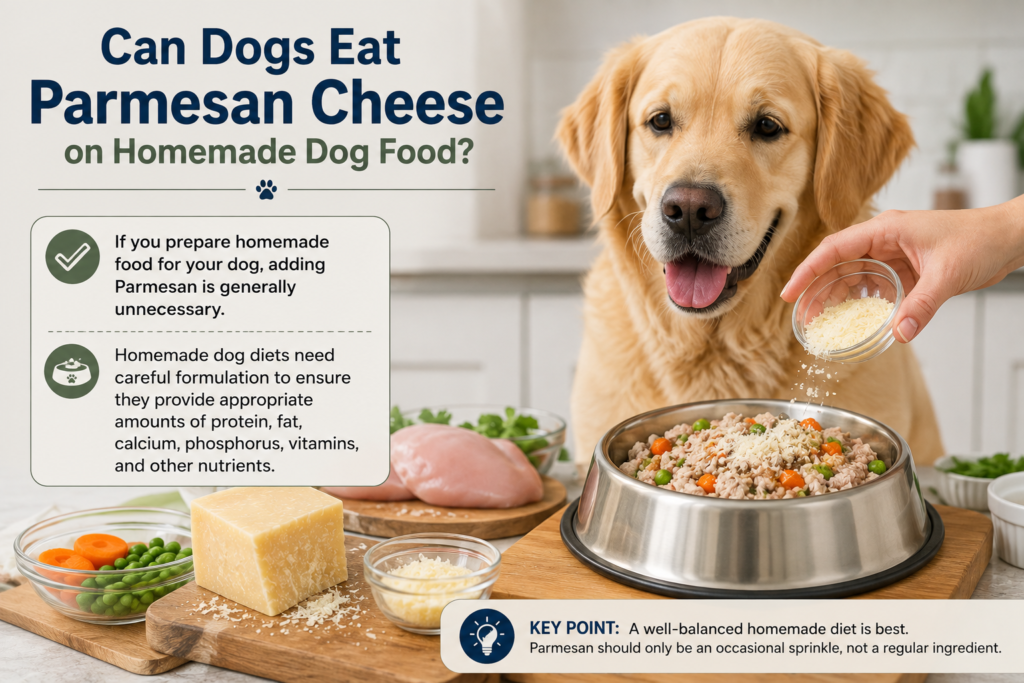
If you feed homemade meals regularly, work with a veterinarian or qualified veterinary nutrition professional to make sure the diet is properly balanced.
A small sprinkle of Parmesan may be acceptable for some healthy dogs, but it should not be used to correct nutritional deficiencies.
Can Dogs Eat Parmesan Cheese Before Bed?
There is no particular benefit to giving Parmesan before bedtime.
A small amount is unlikely to cause problems in a healthy dog, but salty or fatty foods close to bedtime can cause digestive upset in some dogs.
If your dog needs a bedtime snack, a veterinarian-approved dog treat may be a better choice.
Can Dogs Eat Parmesan Cheese After Exercise?
Exercise does not make salty cheese an appropriate recovery food for dogs.
After exercise, the most important thing is access to fresh water and an appropriate balanced diet.
Do not assume that because your dog has burned calories, you can freely give Parmesan.
A tiny amount may be okay occasionally, but it is not necessary for recovery.
Can Dogs Eat Parmesan Cheese During Training?
Yes, a healthy dog may be able to have a tiny amount during training, but portion control is important.
Break treats into very small pieces.
For dogs that train frequently, using lower-calorie rewards can help prevent unwanted weight gain.
If Parmesan is used, keep the pieces extremely small and account for the extra calories in the daily diet.
Can Dogs Eat Parmesan Cheese If They Have Allergies?
Dogs can develop food allergies or intolerances to various ingredients, including dairy proteins.
If your dog has a known dairy allergy, do not offer Parmesan.
Possible allergic reactions can include itching, skin problems, digestive symptoms, or other signs.
A true allergic reaction may require veterinary evaluation.
Do not assume that an aged cheese is safe simply because it contains less lactose. Lactose intolerance and milk-protein allergy are different problems.
Parmesan Cheese vs. Mozzarella for Dogs
Owners sometimes compare different cheeses when deciding which one is safest.
Mozzarella generally has a different nutritional profile from Parmesan and is often softer and less concentrated.
However, mozzarella can still contain fat and sodium.
The fact that one cheese may contain less sodium does not mean dogs should eat it freely.
If you choose to offer cheese, keep portions small and select plain, unseasoned varieties.
The same moderation principle applies when comparing Parmesan with other cheeses.
Parmesan Cheese vs. Cheddar for Dogs
Cheddar is another cheese that dogs may enjoy.
Like Parmesan, cheddar contains fat and sodium.
Neither should become a major part of a dog’s diet.
If a healthy dog receives a tiny amount of plain cheese occasionally, it is usually less concerning than regularly feeding large portions.
When comparing them, look at the nutritional label and choose the product with fewer unnecessary ingredients and a reasonable sodium and fat content.
What Kind of Parmesan Is Safest for Dogs?
If you choose to offer Parmesan, look for:
- Plain Parmesan
- No garlic
- No onion
- No spicy seasonings
- No added sauces
- Minimal ingredients
- Small portions
Avoid Parmesan-flavored snacks and heavily seasoned products.
Plain cheese is easier to evaluate because you know exactly what your dog is consuming.
How to Introduce Parmesan to Your Dog
If your dog has never eaten Parmesan, start with a tiny amount.
For example, you can place a very small pinch on their normal food.
Then observe your dog for the next several hours.
Look for digestive changes such as:
- Gas
- Loose stool
- Diarrhea
- Vomiting
- Excessive thirst
If your dog tolerates the tiny amount, Parmesan can remain an occasional treat rather than something offered frequently.
If your dog reacts poorly, stop giving it.
Frequently Asked Questions
Can dogs eat Parmesan cheese every day?
It is better not to feed Parmesan every day. The high sodium and fat content make it more appropriate as an occasional tiny treat.
Can dogs eat Parmesan cheese in small amounts?
Yes. A tiny amount of plain Parmesan is generally tolerated by many healthy dogs.
Can dogs eat Parmesan cheese if they are lactose intolerant?
Some dogs may tolerate aged Parmesan better than milk because it contains less lactose, but dogs with dairy intolerance can still experience digestive problems.
Can dogs eat Parmesan cheese if they have kidney disease?
Dogs with kidney disease may need controlled sodium and phosphorus intake. Ask your veterinarian before offering Parmesan.
Can dogs eat Parmesan cheese if they have pancreatitis?
Dogs with pancreatitis or a history of pancreatitis may need a low-fat diet. Do not give Parmesan without veterinary approval.
Can dogs eat Parmesan cheese with pasta?
A tiny amount of plain Parmesan may be okay, but pasta dishes often contain garlic, onion, butter, salt, and other ingredients that are not appropriate for dogs.
Can dogs eat Parmesan cheese on pizza?
The Parmesan itself is not generally toxic, but pizza is usually too salty and fatty and may contain ingredients that are unsafe for dogs.
Can dogs eat Parmesan cheese powder?
Only plain Parmesan powder should even be considered, and only in a tiny amount. Seasoning blends may contain garlic, onion, or excessive salt.
Can dogs eat Parmesan cheese rind?
It is best to avoid giving Parmesan rinds because they are hard and can pose choking or digestive obstruction risks.
Can dogs eat Parmesan cheese if they are overweight?
It is better to limit or avoid it because Parmesan adds calories and fat. Lower-calorie treats are usually preferable for weight management.
Can dogs eat Parmesan cheese as a puppy?
A tiny accidental amount is unlikely to be toxic, but puppies should primarily eat a complete puppy diet rather than human cheese.
Can dogs eat Parmesan cheese as a senior?
Healthy senior dogs may tolerate a tiny amount, but dogs with kidney, heart, digestive, or weight concerns may need to avoid salty foods.
When Should You Contact a Veterinarian?
Most dogs that eat a tiny amount of plain Parmesan do not require emergency treatment.
However, contact your veterinarian if your dog:
- Eats a very large amount of Parmesan
- Consumes a large amount of salty food
- Develops repeated vomiting
- Has severe or persistent diarrhea
- Becomes extremely weak or lethargic
- Shows tremors
- Has seizures
- Develops severe abdominal pain
- Has difficulty breathing
- Eats Parmesan containing a potentially harmful ingredient such as onion or garlic
If you are uncertain about how much your dog consumed, tell your veterinarian approximately how much was eaten, your dog’s size, and what other ingredients were present.
Final Verdict: Can Dogs Eat Parmesan Cheese?
So, can dogs eat Parmesan cheese?
Yes, most healthy dogs can eat a very small amount of plain Parmesan cheese occasionally, but Parmesan should not be a regular part of their diet.
The biggest concerns are its relatively high sodium and fat content. Dogs with sensitive stomachs, obesity, pancreatitis, kidney disease, heart disease, dietary restrictions, or dairy intolerance may need to avoid Parmesan altogether.
If you decide to offer Parmesan, keep the portion tiny. A light sprinkle is very different from giving your dog a chunk of cheese.
Always choose plain Parmesan without garlic, onion, spicy seasonings, or sauces.
The key takeaway is simple: can dogs eat Parmesan cheese? Yes, occasionally and in moderation—but it is best treated as a small extra rather than a healthy everyday food.
Your dog’s regular complete and balanced diet should remain the foundation of their nutrition, while treats—including Parmesan—should only make up a small part of what they eat.